
Tick-Based Combat
An OSRS-style combat pipeline with hit chance rolls, accuracy/damage separation, critical hits and multi-combat rules.
Combat runs on a cooldown clock, not on how fast you can click. Every swing is settled by two separate rolls, one deciding whether you connect and one deciding how hard, with a long chain of gear, prayer and potion effects sitting between them. This is what happens on each attack, and what decides the number that appears.
How a swing happens
Your weapon sets the pace. Every melee weapon carries a speed, and that speed is the gap between swings. Attack before it comes round and nothing lands, with no message to say why. Bows, crossbows and thrown weapons run on their own timers, crossbows quicker than bows by default and each item able to carry its own speed, while combat spells go on a fixed one-and-a-half second beat. On Bedrock attacks repeat on their own while you hold your ground with the same weapon in hand; on Java you click for every swing.
Pick an attack style from the settings page of your skills panel. Melee offers Attack, Strength, Defence or balanced, while ranged and magic each offer their own skill or balanced. Experience follows damage, so a dedicated style pours everything into that one skill, balanced splits it, and Constitution takes a share on top of whichever you choose. Ranged and magic turn damage into experience a little faster than melee does.
Outside multi-combat ground a fight is private. You and your target are bound to one another, which is why a monster already fighting somebody will not answer you. Bosses ignore that rule and are open to everyone. Walk far enough off and the binding breaks, the monster drops its aggression and you are free. A hit thrown from twenty-two blocks or further lands for nothing, and a fight counts as over about fifteen seconds after the last hit. While another player has you in combat you cannot teleport away.
Two rolls decide the hit
Whether you connect is settled first, and only two numbers decide it. Melee compares your Attack, ranged your Ranged and magic your Magic, each measured against the target's Defence. Match your target and most swings land. Outlevel it and the odds climb, fall behind and they drop, but never to nothing, so even a hopeless fight lands the occasional hit. Defence stops counting past ninety-nine on either side, and a monster's own attacking level caps there too. Yours does not.
If the swing connects, damage is rolled separately. The weapon's listed damage is the base, and melee scales that by Strength, with heavier weapons rewarding Strength more than light ones. The result is then rolled inside a band: melee reads Attack for the floor and Strength for the ceiling, while ranged and magic read their own skill for both ends. Training therefore does two jobs at once, lifting the worst roll and the best, though levels past a hundred and twenty stop adding to it.
On top of that sits the critical hit, rolled from the gap between your combat level and your target's. A critical skips the random roll, takes the top of the band, adds a further increase and throws up a burst of sparks. The wider the gap in your favour, the more often it fires. An Attack skill cape improves the chance, while a Strength skill cape or a strength amulet raises the ceiling of the band itself. Bosses are the exception on the other side: their swings never drop below a high chance to land, whatever your Defence.
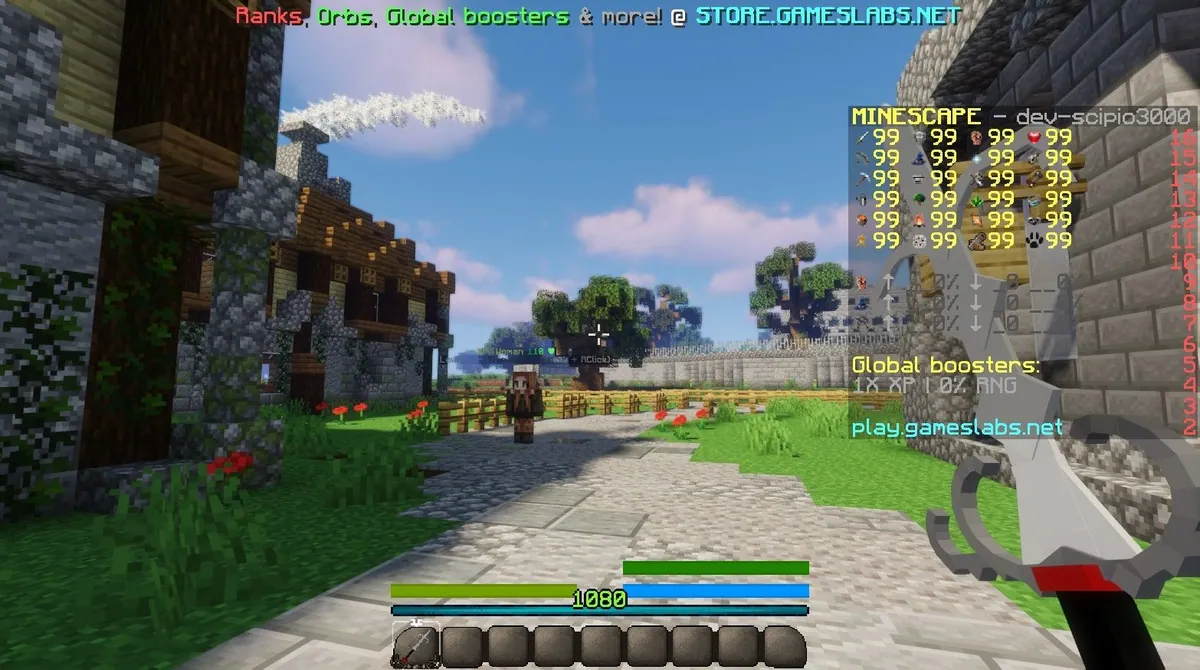
What you are fighting
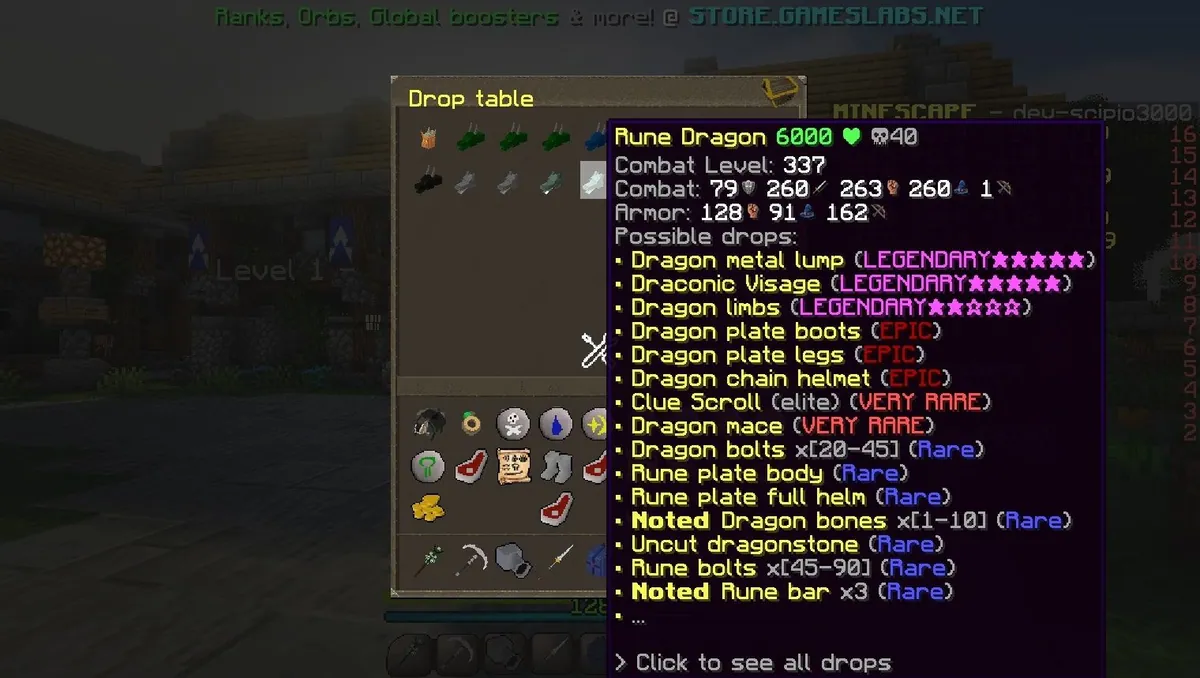
Three hundred and sixty monsters are defined, each with its own Attack, Strength, Defence, Magic and Ranged levels and a health pool. Combat levels are worked out from those stats and run from single digits up past a thousand for the hardest bosses. Some monsters resist a whole style outright, taking reduced damage from it no matter what you bring, so the drop table screen, which prints a monster's combat level, its five stats and its protection against each style, is worth reading before you commit to a trip.
A monster's gear is not decoration. Its protection against melee, ranged and magic is added up from the equipment it wears, which is the same equipment listed on its drop table, and the item in its hand is the weapon it hits you with. Carrying none, it is handed the best weapon its own Attack or Ranged level allows. Behaviour comes from a fixed pattern too: some close to melee, some hold their distance and shoot, some cast, some breathe fire, some fly and some swim.
Aggression has a ceiling. A monster stops hunting you once your combat level reaches twice its own, which is why the early areas go quiet as you grow. Auto-aggressive bosses ignore that and come for you regardless of level. Separately, a monster with a Slayer requirement cannot be attacked at all until your Slayer level meets it, and the game tells you the number when you try. Freezing effects pin a monster in place for as long as they last.
What moves the damage
Between the roll and the hit sits a stack of bonuses. Prayers, potions, jewellery, capes, books, defenders, shields, slayer helmets and the offensive bonuses printed on armour all feed one running total, and that total is capped: however much you pile on, bonuses can at most double your damage. On the way in the same machinery runs in reverse, and there prayer is counted apart from the rest. That matters against bosses, where everything else stops paying out past a ceiling and prayer is what still gets through.
Wearing the wrong class of armour costs you, once for every offending piece on your head, body, legs or feet. Melee or magic pieces worn while shooting, melee or ranged pieces worn while casting, and magic or ranged pieces worn while swinging each take a bite out of your damage. Hybrid pieces are exempt, and a Defence skill cape softens the penalty. A piece you have not got the level to wear contributes nothing at all, neither bonus nor penalty.
On the way in, each armour piece, your shield, and your rings and necklaces contribute separate protection against melee, ranged and magic, and the total is applied on a curve, so more armour always helps but each point helps a little less than the last. Armour-penetration potions cut through it. Protection prayers halve the matching damage and only one can be active at a time; against monsters a strong total protection is deliberately scattered near the top so a little always lands. In player versus player every bonus counts for half in both directions.
Health, sets and wear
You start with a hundred health at Constitution level one and gain ten more for every level after. Natural regeneration is a trickle, roughly a point every five seconds, sped up sharply by the three healing prayers and by a Constitution skill cape, so food is what actually keeps you standing. Food heals a set amount when eaten and some items come in several bites. Equipment can feed you as well: the Saradomin godsword special returns part of the damage you deal as health and prayer, and the divine spirit shield trades prayer points for damage absorbed.
Barrows equipment carries the one real set effect, and it needs all four armour pieces of a single brother plus that brother's weapon in your hand. Dharok's hits harder the lower your health falls. Guthan's sometimes heals you for a share of the damage you deal. Karil's sometimes doubles a ranged hit. Verac's sometimes leaves the target easier to damage for a while. Torag's sometimes absorbs a melee hit outright. Ahrim's weakens the target's own damage for a few seconds after a spell lands.
That equipment wears out. Barrows armour loses a charge each time you are hit, Barrows weapons lose one each time you swing, shoot or cast, and both carry thousands of uses before running dry. A piece at zero stops protecting you and no longer counts towards the set, so the effect quietly vanishes, while a weapon at zero refuses to attack at all. Bob repairs both for a fee, working from your inventory rather than off your back, and a Smithing skill cape halves the price. Cursed weapons carry a far smaller allowance, and the Kalphite whip is built to wear down into an ordinary abyssal whip.
Special attacks
Special attacks all draw on one shared energy bar. It refills on its own from empty to full in five minutes and nothing else charges it. To fire one, hold sneak and attack as normal. The cost varies by weapon, from a small slice for the granite maul up to the entire bar for the heaviest effects, and if you cannot pay you are told you need more energy and swing normally instead.
The four godswords each cost half the bar and each double your accuracy for that hit. Armadyl's is the straight damage option, Bandos's grinds the target's combat levels down, Zamorak's freezes it in place, and Saradomin's returns health and prayer points to you. The granite maul is the cheap one, doubling the hit at the cost of a slower follow-up. The Zamorakian spear knocks the target back and briefly freezes it. The Saradomin sword spends the whole bar on a magic burst and a thunder strike, and the Armadyl crossbow buys accuracy on a shot.
Magic and defence have their own. The staff of the dead and the staff of light each spend a full bar to halve the melee damage that one target deals you for the next minute, as long as you keep the staff in hand. The trident soaks you, which is the condition for its own magic bonus, though being soaked also slows you down. Dragon throwing knives send a second knife after the first. The dragonfire shield absorbs dragon breath aimed at you, up to thirty charges, each charge raising its protection; sneak and right click to spend a charge and breathe that fire back.
The pieces of the combat loop
A fast one-handed melee weapon with the gentlest Strength scaling, which suits it to steady damage rather than big single hits.
Slow two-hander with heavy Strength scaling and the cheapest special on the list: it doubles the hit and lengthens the wait for the next one.
Four heavy two-handers, each with a distinct special costing half the bar and doubling accuracy. Forged at an anvil from three shards, a blade and a hilt with Smithing 80.
Two-handed melee weapon with heavy Strength scaling, whose special knocks the target back and freezes it for a few seconds.
Two-handed melee weapon that spends the entire bar on an added magic burst and a thunder strike on the target.
One-handed bolt launcher whose special spends half the bar to double the accuracy of a single shot.
Thrown weapon with a small area of effect; sneaking spends part of the bar to send a second knife after the first.
Two-handed staff. A full bar halves the melee damage that one target deals you for the next minute, as long as you keep holding it. The staff of light does the same.
Two-handed staff that hits harder while you are soaked, and whose special soaks you on demand for a full bar. Being soaked also slows your movement.
Offhand shield that absorbs dragon breath into charges, up to thirty, each charge raising its protection. Sneak and right click to breathe that fire back for half the bar.